The first buying decision is not the heater’s wattage or price; it is whether aluminium will heat a compatible metal surface indirectly or face the chemical itself. By the end, you will have a practical specification for sizing, controls, safety, quotations, testing and future replacement.
Key takeaways
- Choose indirect heating when the chemical must not contact the resistance element.
- Specify heat load, casting dimensions and independent temperature zones before requesting quotes.
- Require sensor details, overtemperature protection and hazardous-area compatibility in writing.
- Compare testing, drawings, commissioning support and replacement terms—not price alone.
Choose the heating arrangement before choosing the heater material
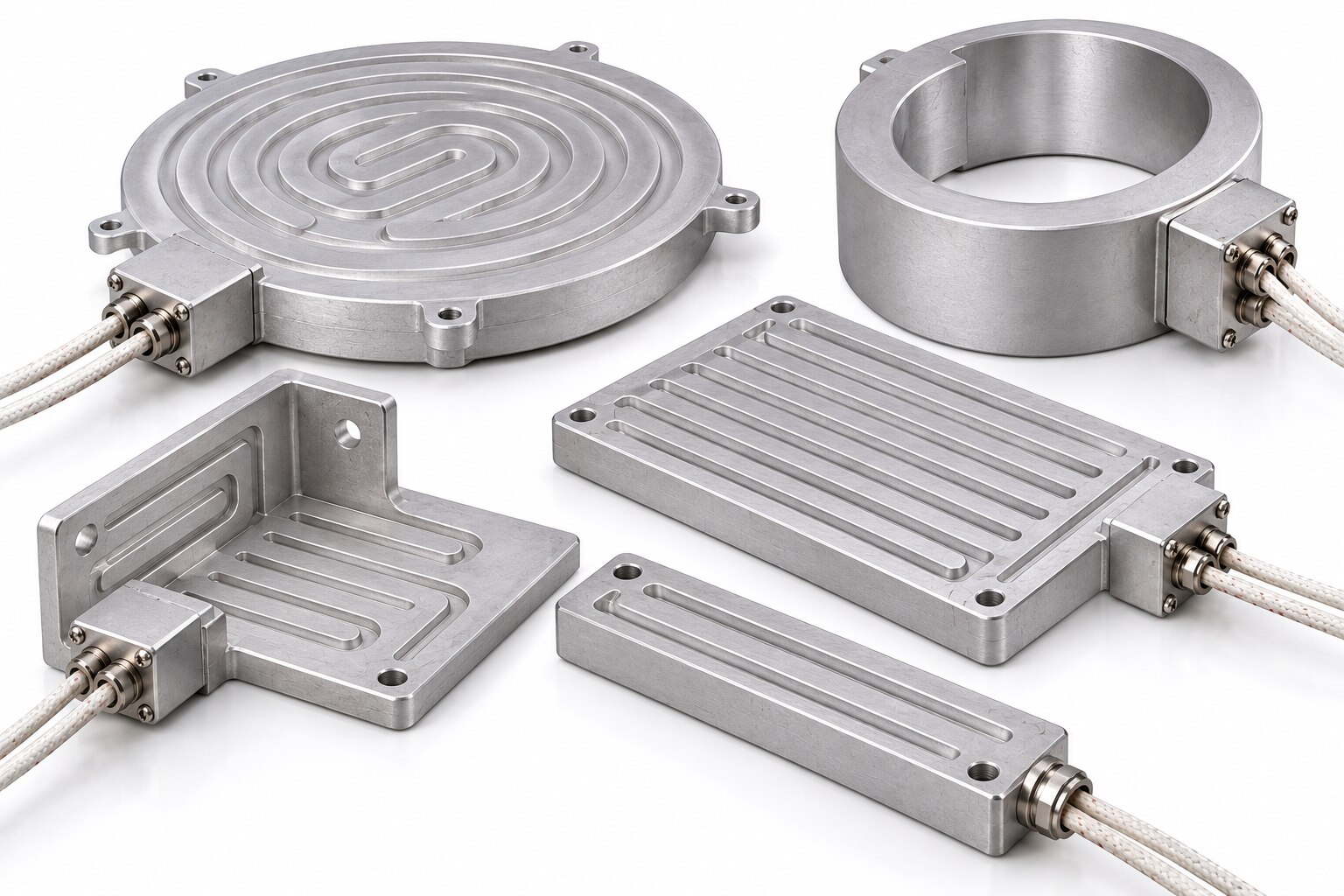
A cast aluminium heater suits indirect heating of conductive metal surfaces: vessel jackets, tank bottoms, dies, platens, pipes, manifolds, extruder barrels and nozzles. The resistance element sits inside a machined aluminium casting, which transfers heat by conduction; it must not contact the chemical solution.
Aluminium cast heaters for chemical plants in Pune are therefore a poor choice for direct liquid heating, nonconductive vessel walls, very high surface temperatures or severe chemical exposure.
| Option | Suitable arrangement | Choose it when | Safer alternative or warning |
|---|---|---|---|
| Aluminium cast heater | Clamped or bolted to a metal surface | You need even indirect heating of an aluminium, steel or other conductive component within the casting and element temperature limits | Do not expose the casting to the process fluid |
| Stainless-steel immersion heater | Sheathed element immersed in liquid | The solution needs direct heating and its concentration, pH, contaminants and cleaning chemicals support stainless steel | Use titanium, PTFE/PFA or another alloy when stainless steel can corrode |
| Titanium immersion heater | Direct liquid heating with high corrosion resistance | Chlorides or aggressive chemical solutions exceed stainless-steel compatibility | Confirm the chemical, temperature and galvanic-contact assessment |
| Ceramic or silica heater | Radiant or non-contact heating | The process demands a high surface temperature or the vessel is nonconductive | Protect brittle parts from impact and thermal shock |
Before ordering, identify whether aluminium touches only the heated metal or also the process. Strong acids, caustic alkalis and chloride-bearing liquids can attack aluminium and contaminate the batch. If the element must enter the solution, give the supplier concentration, operating temperature, pH and cleaning chemicals, then require documented sheath compatibility.
A drawing and heat-load review should precede any price comparison.
Specify heat load, casting geometry and temperature zones
A usable specification starts with the heat load: state what must be heated, its starting and target temperatures, heat-up time, batch mass or flow rate, insulation, ambient losses and duty cycle. Add supply voltage, phase, total kW and allowable surface temperature; identical kW ratings do not guarantee identical heating performance.
1. Describe the process load: liquid, vessel, die, pipe, plate or machine part; heating, holding or cycling duty; mixing or circulation; and continuous or intermittent operation.
2. Send a dimensioned drawing showing casting length, width, thickness, curved radius, mounting-hole pattern, clearances, clamping points, terminal orientation and cable exit direction.
3. State the contact requirements: mating-surface flatness, permitted warpage, machining tolerance, surface finish and maximum clamping pressure. An air gap or uneven tightening creates hot spots even when average watt density looks safe.
4. Divide the casting into temperature zones and specify each zone’s kW, control temperature, thermocouple type and exact sensor position. Identify whether sensors sit in pockets, near the process surface or between elements.
5. Provide the casting alloy, process-fluid temperature, chemical exposure, contamination limits and nearby dissimilar metals. Confirm that aluminium will not corrode, contaminate the product or form a damaging galvanic couple.
For a custom cast heater in pune, request a drawing with these values before accepting a quotation. Also specify terminal covers, lead protection, connector type, zone labels and replacement-unit interchangeability; without them, installation and future shutdown work remain undefined.
Define sensors, electrical protection and hazardous-area limits
Specify temperature control as a measured process loop, not as a heater wattage alone. Identify the sensor, its position, operating range, accuracy, controller action, alarm limits and independent over-temperature cutoff. A surface-mounted RTD suits stable metal temperatures; a thermocouple responds faster but needs correct grounding and extension cable.
Put these details on the electrical drawing and purchase specification:
- Sensor type, sheath material, insertion depth and mounting location
- Normal process temperature, high-temperature alarm and hard cutoff temperature
- Controller output and the contactor or solid-state relay rating
- Nominal voltage, actual plant supply, phase grouping and heater resistance
- Protective earthing point and insulation-resistance test voltage
- Short-circuit device, overload protection, isolator and cable size
- Terminal-box enclosure rating and safe access requirements
- Reset method after a limit trip
Treat each safeguard separately. IEC 60519-1 addresses general electroheating safety, while IEC 60529 defines enclosure ingress-protection ratings; an IP rating does not prove chemical compatibility or prevent overheating. Confirm that protective earth continuity, insulation, over-temperature limitation and short-circuit protection are tested before energising.
A quotation for industrial electrical heaters in Pune that assumes a supply can produce the wrong current and phase arrangement.
Mark the hazardous-area classification on the drawing, such as Zone 1 or Zone 2, gas group and temperature class under the applicable IEC 60079 design. Use certified equipment, glands and terminal enclosures for that classification; a standard aluminium casting is not automatically permitted in a classified area.
Separation from the chemical also requires a compatibility review.
Compare quotations by scope, testing and supplier capability
A cast in heater price in Pune is comparable only after every supplier prices the same drawing, heat load, zones and electrical arrangement.
Request a dimensioned drawing and written heat-load confirmation before reviewing the number; a quote labelled “industrial electrical heaters in Pune” could describe a band, cartridge or tubular heater instead of a cast-in assembly.
Ask each aluminium cast heater supplier in Pune to state:
- Casting alloy, overall dimensions, machined faces, mounting holes and thermocouple pockets
- Rated kW, voltage, phase grouping, zone count, resistance per zone and duty cycle
- Included terminals, covers, guards, cables, controllers, SSRs or contactors
- Insulation-resistance, dielectric-withstand, resistance, dimensional and functional test reports
- Packing, freight, GST, installation, delivery time and warranty
- Spare thermocouples, connector type, zone labels, replacement-unit interchangeability and retention of final casting and machining drawings
| Comparison point | Like-for-like question | Cost or risk if omitted |
|---|---|---|
| Casting scope | Are alloy, machining, cooling passages and mounting features included? | A cheaper rough casting may need costly site work. |
| Controls | Are sensors, SSRs/contactors and protection included for the actual 415 V three-phase or single-phase supply? | Nominal kW can hide incompatible wiring and protection. |
| Testing | Does the report show measured values, test voltage and inspection results? | A passed claim without figures is difficult to verify. |
| Supplier capability | Can the supplier reproduce the casting and support shutdown replacement? | Lost drawings can turn a failed heater into a redesign. |
Saket Enterprises 08048052723 is worth assessing by whether it supplies those documents and replacement details, not by catalogue breadth. Do not accept aluminium as immersion-compatible without fluid concentration, pH, contaminants and cleaning-chemical review; use a specified sheath material when the element contacts the solution.
Related product
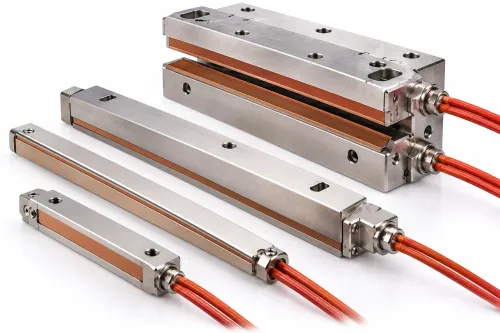
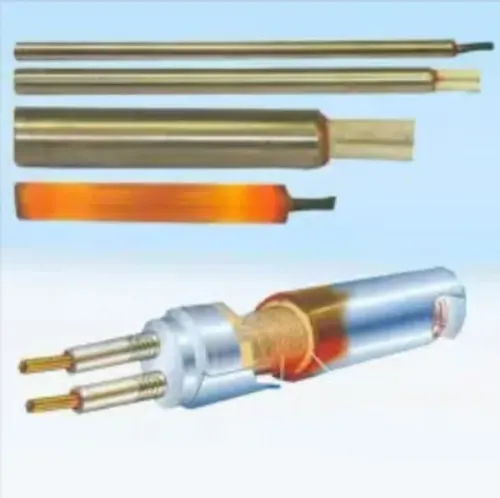
 | CAST-IN HEATERS Tubular heating elements embedded in aluminium alloy or Brass, providing uniform heat transfer and long life.The heater can be manufactured with... View product → |
Plan installation, commissioning, maintenance and replacement
Prevent hot spots by correcting the mounting interface before energising the heater. A warped surface, uneven clamping or an air gap leaves part of the casting poorly coupled to the heated equipment, so concentrated wattage can overheat the element while the average temperature looks normal.
- Check the machined mounting face for flatness, remove burrs and confirm full contact across the casting.
- Verify bolt positions, clamping pressure and expansion clearance against the approved drawing; do not tighten one side fully before the other.
- Confirm the heater’s resistance, insulation resistance, protective earth continuity and phase connections before applying power.
- Match the actual site supply, such as 415 V three-phase or a single-phase circuit, to the specified resistance, cable, contactor or SSR and short-circuit protection.
- Fit terminal covers and verify safe access, enclosure ingress protection and over-temperature limitation. IEC 60519-1 covers electroheating safety, while IEC 60529 classifies enclosure protection.
Commission each zone separately. Compare sensor readings with the die, barrel, vessel or process interface temperature; a sensor beside the element responds quickly but can read hotter than the workpiece. Record heat-up time, zone current and stable operating temperatures.
During planned shutdowns, inspect terminals for discoloration or looseness, check earth continuity and insulation, and use thermal imaging to find uneven heating. Replace a casting showing cracks, distortion or persistent hot spots rather than compensating with higher power.
Keep spare thermocouples, connectors and terminal covers, label every zone, and retain final casting and machining drawings for an interchangeable replacement.
Frequently asked questions
When should a chemical plant choose an aluminium cast heater?
Choose one when a resistance element must heat a conductive metal surface indirectly, such as a vessel jacket, tank bottom, die, platen, pipe or manifold. Keep the casting and element out of direct contact with the chemical solution.
What information should you provide when ordering a custom cast heater?
Provide the required heat load, heated-surface dimensions, casting geometry, operating temperature, warm-up time, supply voltage, phase, number of temperature zones and sensor locations.
Which electrical and safety details belong in the quotation?
Request the element wiring, terminal arrangement, sensor type, control method, independent overtemperature protection, insulation test results and any hazardous-area limits or exclusions.
How should you compare aluminium cast heater quotations in Pune?
Compare the included drawings, casting alloy, machining, testing, documentation, installation support, commissioning assistance, warranty scope and replacement lead time alongside the quoted price.
Keywords